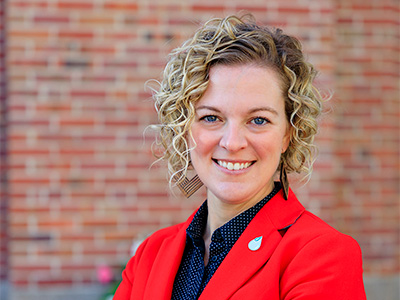

Growing up on a corn and soybean farm in northeast Nebraska, one DWFI intern never imagined her upbringing would eventually lead her to the intersection of water law, land governance and global food security. But that's exactly where Lexi Bodlak's path has taken her-and a case study in Ghana with DWFI through her fellowship with the Clayton Yeutter Institute of International Trade & Finance helped connect the dots.
A journey to Ghana sharpens her focus
The oldest of three children, Lexi eventually made her way to Lincoln, Nebraska to study agricultural communications and natural resource policy at the University of Nebraska-Lincoln. Her interest in food security was long-standing, but it was a Yeutter Institute fellowship that sharpened her focus and led her to connect with DWFI. DWFI's Nick Brozović, director of policy; Nicole Lefore, associate director; and Renata Rimšaitė, Jude Cobbing, and Erin Anders, all senior program managers; helped facilitate a spring break experiential learning opportunity to Ghana for Yeutter Student Fellows to Ghana.
"Working with the DWFI team on a case study in Ghana made me realize that water security comes even before food security," she reflected. "I grew a real interest in land governance and water law through that experience."
That case study sparked a desire to continue building those relationships and learn more from DWFI, a global leader in her own backyard.
Diving into U.S. groundwater policy
Under Renata's supervision, Lexi's internship with DWFI centered on two major research projects. The first was a comparative study of water permitting structures across the United States, focusing on groundwater and agricultural irrigation. She conducted 10 interviews to learn more about different regions' approach to the permitting process.
The second project was an in-depth case study on Arkansas, a state known for its unique water demand and its voluntary, education-based approach to water management. Lexi interviewed nine individuals across a wide range of stakeholder groups: researchers and academics, industry professionals, technology providers and farmers.
"I spent a lot of time reading state statutes, and then I'd talk with an expert who would say, ‘Yeah, this is how it's written, but this is how we usually do it.'" she said. "That really reinforced the value of interviews. You learn so much more from the people implementing these things day to day."
Research results from Lexi's internship experience will be finalized and published in the coming months and shared on the DWFI website.
Building research skills and finding her niche
One of the most meaningful parts of the internship was synthesizing interview findings into clear, actionable themes-a task that pushed Lexi to exercise critical thinking and communicate with a specific audience in mind.
"I love taking in a lot of information, but I still struggle with making things concise," she admitted. "This experience was a great way to exercise that skill while keeping my stakeholders in mind."
With a farmer for a father and a lawyer for a mother, Lexi now jokes that pursuing agricultural law was always in the cards; she just needed the experience to see it clearly. Working alongside DWFI's policy team helped her envision what a career at the intersection of academia and law could look like.
"The internship helped me hone my interest in natural resource policy, and specifically water," she said. "I'm not exactly sure where I'll be in five years, but hopefully I'll have a law degree and be doing something with natural resources and water in Nebraska."
Lexi recently received the Water for Food - International Arid Lands Consortium (IALC) Student Impact Award which supports undergraduate students at the University of Nebraska studying water and food related issues. It is awarded by DWFI to recipients who have made a meaningful contribution to the institute's mission and to collaborative endeavors relating to sustainable agriculture and natural resource practices in arid and semiarid regions of the world.
Advice for future interns
Lexi shared three pieces of advice for students considering a DWFI internship:
- Use your student status. People are far more willing to be candid when you frame yourself as a curious student looking to learn. That openness can unlock insights a professional-to-professional conversation might not.
- Be intentional about meeting people outside your team. Internships are for professional development, yes-but also personal growth. The relationships you build, even in areas outside your direct project, can last for years.
- Stay curious. "You don't know what you don't know until you realize you don't know it," she said. Continuing to ask questions, even when you think you already understand, is what separates good research from great research.
Through activities like internships, awards and its robust DWFI student support program, DWFI strategically develops the knowledge, skills and capabilities of the next generation of water and food leaders. This commitment creates a pipeline of talented professionals by fostering expertise in students like Lexi, whose experience in policy research is paving the way for a future career in natural resource law.
Students interested in internships with DWFI's policy team can reach out to Renata Rimšaitė at rrimsaite@nebraska.edu.