

In Nebraska, we have a unique way of managing our water resources through 23 locally-led, watershed-based NRDs. They work directly with the people within their district to conserve, preserve, and wisely use the natural resources in their area. This includes monitoring and, in some districts, offering programs to assist individuals in keeping their water resources safe for drinking water.
- History of the NRDs: https://www.nrdnet.org/nrds/about-nrds
- Programs of the NRDs: https://www.nrdnet.org/programs
- Finding your NRD: https://www.nrdnet.org/nrds/find-your-nrd
Stay up to date on Water Quality Information
The Nebraska Department of Water, Energy, and Environment (NDWEE) regulates community water systems 365 days a year. If you wish to inquire about the water quality of a community water system, begin by contacting the city hall or village office. Request a copy of their water system’s Consumer Confidence Report (CCR). All community water systems must make their CCR available to their customers and anyone who requests a copy. As per the federal Safe Drinking Water Act, community water systems must test for approximately 100 potential contaminants on set schedule. The CCR will outline the regulated contaminants that were detected in the system, and if the contaminants exceeded the maximum contaminant level allowed.
- Public Water Supply System test results on Drinking Water Watch:
- Access information by Nebraska counties interactive map lookup: https://drinkingwater.ne.gov/Maps/Map_Template.jsp
- Access information through water system search: https://drinkingwater.ne.gov/index.jsp
NDWEE also monitors public beach water quality during the recreation season, usually mid-May through mid-September. Each week, recreational lakes are published at the site below.
- Test results for public recreational lakes across Nebraska
Ordering Water Quality Test Kits
Testing water is the first step in determining whether a water source is safe for drinking water and cooking. The state laboratory (lab), the Nebraska Public Health and Environment Laboratory, offers testing for a comprehensive suite of potential contaminants. They also have a list of other certified labs throughout Nebraska, which utilize the same procedures and testing methods for contaminants as set by the Environmental Protection Agency (EPA) to ensure standardized results for all public water supply systems. These labs generally have certain contaminants but are not as comprehensive in their analyses as the state lab.
Also, sometimes, a local NRD may offer free testing to their community members, so it is always recommended for an individual to reach out to their local NRD for more information.
- Nebraska Public Health and Environment Lab: https://dhhs.ne.gov/Pages/Lab-Price-List.aspx
- Nebraska Certified Labs: https://dhhs.ne.gov/Public%20Health%20Lab%20Documents/certified%20labs.pdf
- UNL Water NebGuide – Certified Water Testing Laboratories in Nebraska: Lists approved government and commercial laboratories and explains water testing certification for drinking water.
https://go.unl.edu/certified-labs
- Check with your local NRD or local health department for potential water testing services
- See “Find your NRD” under “Learn more about the Natural Resources Districts”
Water Quality Testing Information
All water from natural sources contains dissolved substances. These substances are often called contaminants, especially when the amounts present are at possibly harmful or problematic levels. The substances in water can result from either natural processes or human activities. At low concentrations, many do not cause known harmful effects and may be beneficial. Research shows some substances may be harmful only when present at high enough concentrations, but even lower levels of exposure over time may adversely affect portions of the population.
The only way to know if the water you use for drinking and cooking contains potentially harmful substances at levels high enough to be of concern is for the water to be tested. Analytical laboratory testing can determine what substances are present and their concentration levels. Testing provides private well owners with the necessary knowledge to protect the health of their family.
The EPA sets the thresholds called "maximum contaminant levels" (MCLs), for drinking water contaminants. Most thresholds are based on potential health effects from long-term exposure above the MCL unless specified as short-term exposure. Public water supplies (PWSs) have mandatory testing requirements; state regulatory agencies such as the NDWEE, as well as the EPA, enforce compliance to the standards. Although private wells are not federally regulated, it is just as important as water from public water supplies. It is common practice to apply the contaminant thresholds identified for PWSs to private wells.
UNL Extension has a series of drinking water guides to assist private well owners with better understanding water quality topics. NebGuides cover minerals and contaminants in drinking water which includes information on sources, health effects, testing, test results, and management and treatment options.
- UNL Water NebGuide - Testing for Quality: Discusses waater testing methods for public and private water systems.
https://go.unl.edu/testing-for-quality
- UNL Water Drinking Water NebGuides:
https://water.unl.edu/article/drinking-water/nebguides/
- EPA Maximum Contaminant Levels, reference guide for checking results against to determine health risk: https://www.epa.gov/ground-water-and-drinking-water/national-primary-drinking-water-regulations
Learn more about Water Management in Nebraska
Water resources, surface water and groundwater, are intricately connected – think about the water cycle! In Nebraska, a team of individuals work together to monitor, regulate, and protect water resources, ensuring that their quantity and quality best protect public health, livelihoods, and environmental processes to prosper.
The water droplet visualization below shows the different groups that work together in Nebraska on water resources management. At a watershed level, NRDs work mostly with groundwater quality and quantity. At a state level, DWEE works in multiple water resources areas – surface water and groundwater – to ensure the resources are safe for intended uses. Nebraska Game and Parks Commission (NGPC) and Nebraska Department of Agriculture (NDA) also contribute to water resources management.
Other resources include: the Water Quality Programs page on the DWEE website to become more acquainted with the manifold areas DWEE assists in water quality management; the Nebraska WAVES website created by UNL water professors to learn more about water resources management; a link to explore University of Nebraska researchers who specialize in different aspects of water sciences; and a link to find a local NRD. Once an NRD is identified, each one has their own webpage and can be further explored.
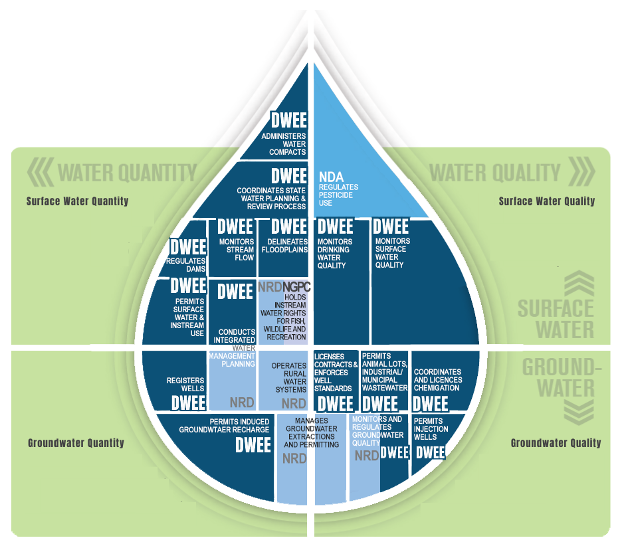
Graphic credit: Nebraska Department of Water, Energy, and Environment
- Water quality programs at DWEE: https://dwee.nebraska.gov/groundwater
- Drinking Water:
- Nitrate in Drinking Water Study: https://dwee.nebraska.gov/groundwater-drinking-water/drinking-water/nitrate-drinking-water-study
- Nebraska WAVES: https://nebraskawaves.org/
- Find Nebraskan water researchers: Research Network - Directory | Nebraska Water Center | Nebraska
- Finding your NRD: https://www.nrdnet.org/nrds/find-your-nrd
- Drinking Water: