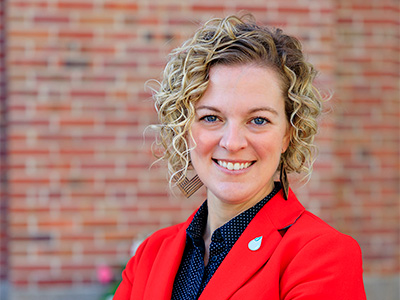
Water security isn't just about having enough water—it's about knowing what's in it. That's the focus of the latest episode of the Water for Food Podcast, where host Frances Hayes, DWFI Director of Communications and Public Relations, goes behind the scenes at the Water Sciences Laboratory at the University of Nebraska-Lincoln with lab manager Jennah Duncan.
The Water Sciences Lab operates jointly under the Nebraska Water Center and DWFI, giving both entities access to its testing and research capabilities, along with the many other clients it serves across UNL, Nebraska and the world. Duncan, who has managed the lab for just over a year, started out as a forensic science major before falling into water chemistry through hands-on lab work—working her way up from intern to technician to manager.
More than 250 tests, from nitrate to nanoplastics
The lab runs over 250 different testing methods for clients that range from University of Nebraska-affiliated researchers to international submissions from countries including Argentina, Portugal and Mexico. Right now, PFAS, herbicides and nitrate isotopes make up the bulk of the lab's workload. Among the more unusual requests, the lab also measures hydrogen levels in cow burps. Because hydrogen acts as a "building block" for methane production, monitoring these levels reveals digestive efficiency and helps evaluate greenhouse gas reduction strategies.
To do this kind of work, the lab relies on specialized equipment like mass spectrometry and isotopic analysis, tools far more sophisticated than at-home water testing strategies. Duncan explained that while simpler tests like nitrate analysis rely on mixing reagents and measuring color intensity, compounds like PFAS require separating out individual molecules by mass or charge using instruments such as liquid chromatography-mass spectrometry (LCMS). It can be a complicated process, but the lab is up to the task.
Why "forever chemicals" are so hard to pin down
PFAS—short for per- and polyfluoroalkyl substances—are synthetic chemicals found in everything from makeup and nonstick cookware to waterproof products. Because there are thousands of individual PFAS compounds, testing for them is far more complex than testing for something like nitrate. The lab currently uses two EPA-approved methods, EPA 1633 and 537.1, to detect them, with 1633 being the more widely used method across other labs nationally.
A two-way relationship between water quality and agriculture
Duncan described the lab's role as something of an early warning system for agricultural decision-making. By testing groundwater and soil, the lab can help producers see whether changes in farming practices are having a positive or negative effect—data that can inform decisions before problems escalate. While Duncan said she isn't directly involved in policy, the lab connects clients with relevant resources and policymakers when results raise questions.
The lab works closely with Nebraska's Natural Resources Districts, regularly testing samples for pesticides and PFAS on their behalf. Nitrate remains one of the state's most persistent water contaminants, largely tied to agricultural practices, a challenge Duncan noted is mirrored in agricultural regions worldwide, even as each region's water issues carry their own local character.
A project she's proud of—and what's next
Among her proudest achievements, Duncan pointed to the lab and the Nebraska Water Center's Know Your Well project, a participatory community science initiative that helps rural Nebraskans test their private wells and understand what to do if results raise red flags.
Looking ahead, the lab recently secured a grant for new equipment, including an upgraded isotope ratio mass spectrometer (IRMS) and new ICP-MS and ICP-OES instruments for metals analysis. Perhaps most notably, a new GC triple quadrupole system will allow the lab to begin analyzing microplastics and nanoplastics for the first time, a capability Duncan said clients have been requesting for years.
The Water Sciences Lab has been operating for roughly 30 years and employs both full-time staff and students. Its services are open to anyone, not just university-affiliated researchers.
Duncan emphasized that water science is a constantly evolving field: practices once considered safe can change as new research emerges, and the lab's job is to adapt accordingly.
Listen to the full episode of the Water for Food Podcast for more on the science protecting one of our most essential resources » https://waterforfood.nebraska.edu/our-work/communication/podcast