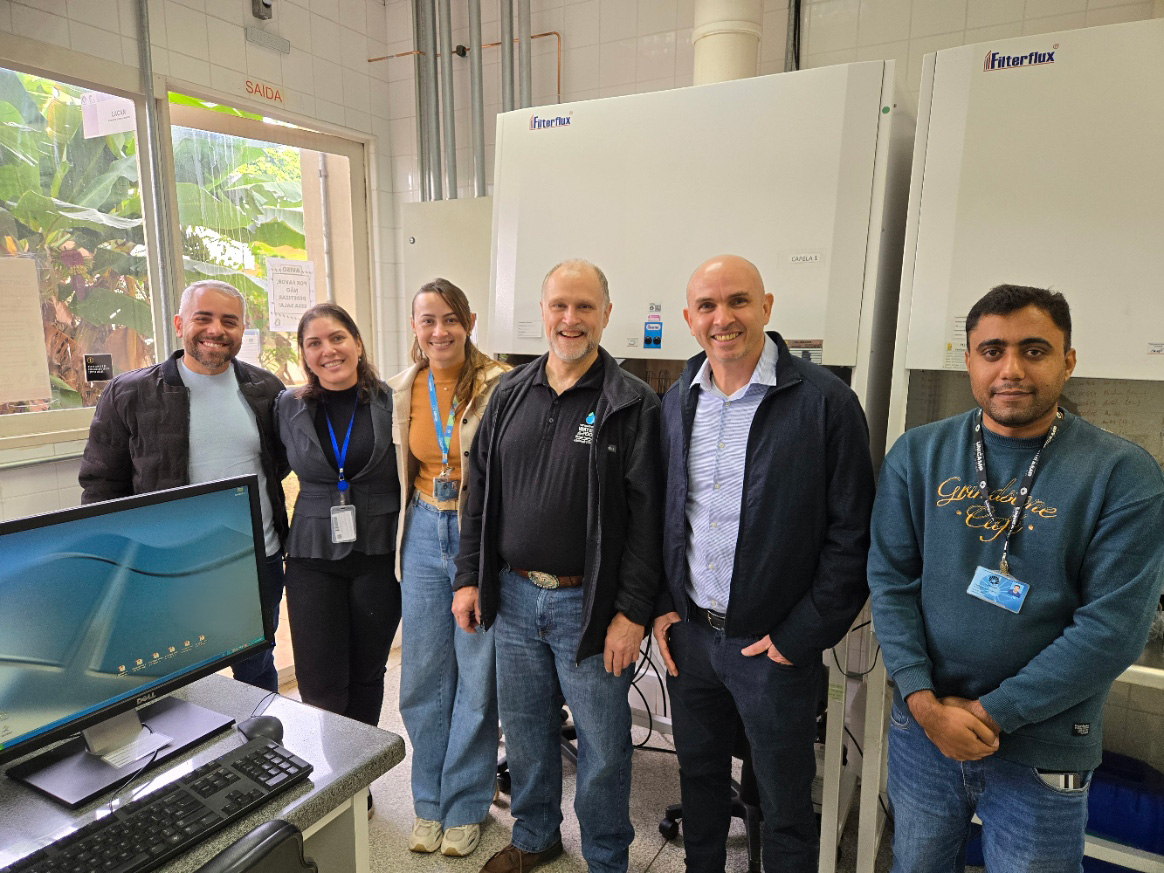
Photo caption: Dan Snow tours a facility with faculty and students from the State University of Campinas in Brazil. From left to right: Michel Branco, Jacqueline Malvestiti, Lais Sommaggio, Daniel Snow, Renato Dantes and Zain Abdin. Photo credit: Dan Snow | UNL Water Sciences Lab / DWFI
In the modern landscape of scientific research, discovery rarely happens in isolation. For Dan Snow, lab director of the Water Sciences Laboratory (WSL), a part of both DWFI and the Nebraska Water Center, his recent experience as a Fulbright Specialist in Brazil serves as a powerful testament to the necessity of international cooperation. By bridging geographic and cultural divides, these exchanges are not merely professional development opportunities; they are vital conduits for advancing science on a global scale.
A strategic exchange
A program of the U.S. Department of State, the Fulbright Specialist Program is a unique opportunity for U.S. academics and established professionals to engage in two- to six-week, project-based exchanges at institutions across the globe.
Unlike long-term fellowships, this leaner program focuses on short-term, high-impact visits and the rapid exchange of expertise, culture and methodologies. For Snow, the opportunity to visit Brazil was a direct outcome of a long-standing collaborative relationship with Renato Falcão Dantas, a professor in the School of Technology at the State University of Campinas (UNICAMP) in São Paulo, Brazil. Dantas and his spouse Joyce Cristale, also a UNICAMP professor, both spent an extended amount of time in Nebraska during the 2023-2024 academic year, with Cristale working directly in the WSL with Snow’s team to learn about their advanced environmental testing methods.
Dantas worked with Snow to submit a proposal to the Fulbright Specialist Program under the title of “New Global Pollution Challenges” and paved the way for his visit to UNICAMP. Snow emphasized that the success of such an exchange relies on mutual benefit. "It has to be mutually beneficial... everybody gets something out of the process." Snow’s itinerary was packed with lectures, facility tours and collaborative meetings.
Knowledge sharing
One of the most tangible outcomes of Snow’s visit was the transfer of complex technical knowledge, particularly regarding the difficulties in accurately detecting and sampling ultra-low levels of PFAS (per- and polyfluoroalkyl substances) in the environment.
Snow’s team at the lab has been at the forefront of developing new methods for analyzing these compounds. During his time in Brazil, Snow’s tours took him to UNICAMP’s main campus, where he was highly impressed by the sophisticated equipment and thriving faculty within the chemistry department. Later in the week, he visited Brazil’s “SIRIUS” synchrotron light source, a state-of-the-art particle accelerator facility—the country's equivalent to the United States' Argonne National Laboratory. Snow also shared the methods developed and used in Nebraska to measure a wide variety of materials while engaging with Brazilian researchers. This knowledge transfer allows the Brazilian team to avoid the steep learning curve his own lab faced, helping them accelerate their research trajectory.
"I can see how we here are doing a great job at certain things and how we are leading the pack in certain areas, and you can't get that perspective by staying here [in Nebraska]," Snow noted. "You have to go to other places and compare what you're doing to what everyone else is doing."
Inspiring the next generation
Beyond the data and the laboratory equipment, the most energizing aspect of the trip for Snow was the interaction with students. During a seminar at the UNICAMP Science and Engineering campus, undergraduate students approached him with curiosity about his career path and the motivations behind his work.
"That sort of interaction, especially with students who are just starting out, is incredible," Snow said. "You feel like you can actually touch and influence the direction of young students on what career path they take and how they view the world."
As Snow looks toward future collaborations—including potential workshops and continued student exchange programs with Brazilian partners—he remains a staunch advocate for the value of travel. For him, the global perspective gained from these trips is the fuel that keeps scientific passion alive, proving that the most important connections in science are often the ones made across borders.
Driving excellence through partnerships
A recurring theme of Snow’s experience is the concept of breaking isolation. Whether it is a research institute in Brazil or the Great Plains, institutions often face the challenge of being overlooked if they do not actively engage with the global community.
"Unless we did this type of international work, nobody would pay any attention to Nebraska. Active international collaboration is essential to building institutional reputation and fostering growth," he said.
Snow’s Fulbright Specialist visit underscores the critical importance of active global engagement in maintaining research excellence. By fostering direct, high-level collaboration with international peers like those at UNICAMP, the University of Nebraska and DWFI strengthen their reputation as leaders in water science, moving beyond regional boundaries to participate in a vital global exchange of knowledge. This partnership not only accelerates scientific breakthroughs—such as in understanding how to manage PFAS in Nebraska —but also creates essential pathways for student exchange and cultural dialogue, ensuring that Nebraska remains at the forefront of the global effort to solve complex water challenges.