
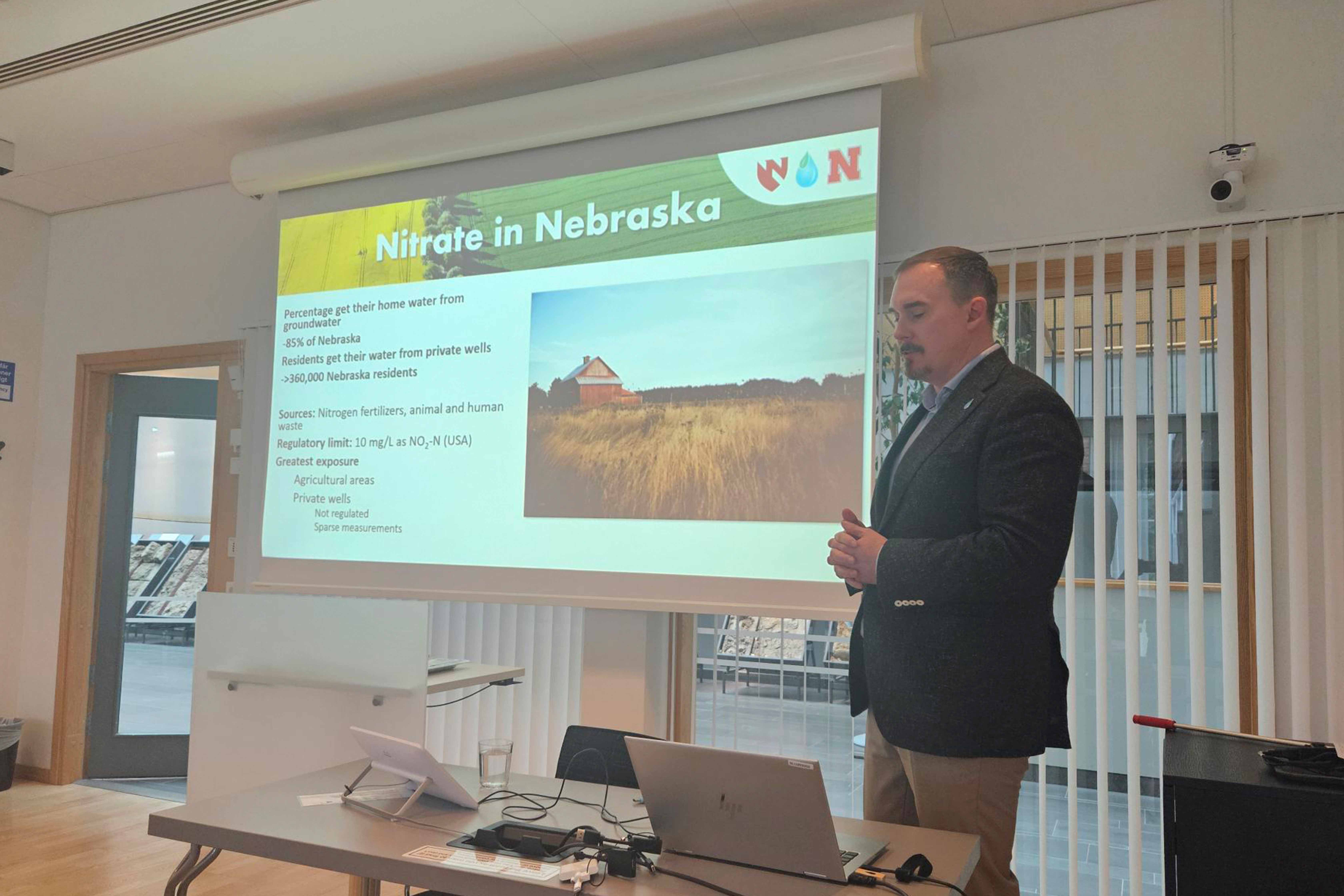
 Caption: DWFI Director of Water, Climate and Health Jesse Bell presents during the workshop in Uppsala, Sweden on August 28, 2026. Credit: Jennie Barron | SLU
By Nicole Lefore, Associate Director, Daugherty Water for Food Global Institute
“As researchers, we need to learn and collaborate faster across borders to strengthen water security and climate resilience in an increasingly unpredictable agricultural landscape,” said Jennie Barron, professor of agricultural water management at the Swedish University of Agricultural Sciences (SLU).
Addressing these shared challenges for agricultural water management brought researchers from the Daugherty Water for Food Global Institute (DWFI) at the University of Nebraska–Lincoln and SLU together in Uppsala, Sweden, on August 28 for a joint seminar on resilience and water security for agriculture.
Following World Water Week in Stockholm, the seminar provided an opportunity for colleagues from the two institutions to share research, approaches and experiences across a range of disciplines and geographies. Presentations covered agricultural water management; remote sensing; precision agriculture; soil and crop science; irrigation business and innovation; water quality; and intersection of agriculture and public health.
Presentations from both DWFI and SLU examined how different types of data can be used to better understand agricultural water use and maximize crop water productivity, particularly in soybean and corn (maize) production. DWFI researchers discussed combining remote sensing with ground-based information to analyze crop- and site-specific agricultural water management. A presentation from Emmanuel Ngonga, an SLU/International Institute of Tropical Agriculture (IITA) Ph.D. student highlighted work in Zambia to validate soil and climate data and relate these data to remotely sensed estimates of water balance for soybean and corn.
Other presentations addressed the broader systems surrounding agricultural water management. Discussion of the irrigation business ecosystem and innovation considered the role of industry and entrepreneurship in expanding supply of suitable, agricultural water management technologies. The discussion then expanded to water quality and health, including research on agricultural water quality and persistent pollutants such as PFAS, with a Swedish case study.
The Swedish University of Agricultural Sciences (SLU) SLU is Sweden’s primary university studying agricultural water management in Sweden to inform policy, support policy implementation, and engage with agricultural extension. SLU’s focus includes climate adaptation, water quality and farm-level infrastructure as traditional rainfed systems face both water shortages and flooding during the growing season.
Alongside the presentations, the seminar included time for discussion and informal exchange. The two institutions explored potential for faculty exchange and student field experience. Bringing together researchers working on different aspects of water, agriculture and health provided a setting to explore areas of shared interest and potential future collaboration between SLU and DWFI. By uniting international expertise, the partnership directly supports DWFI’s mission to build global agricultural resilience and ensure food and water security for all.