

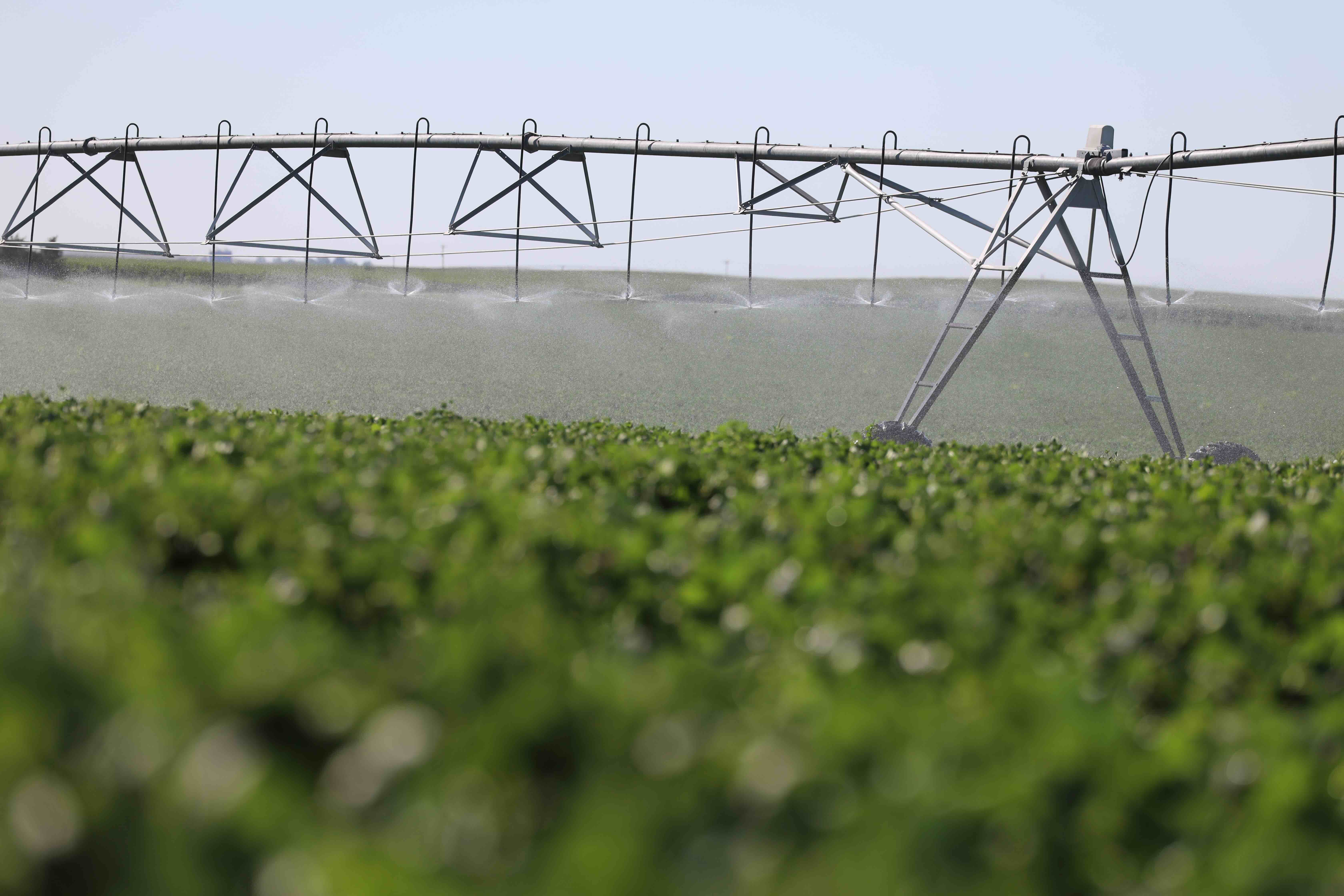
Photo Caption: A center pivot irrigation system operates in a soybean field in Western Nebraska. Credit: David Munyaneza | DWFI
By Harshanee Jayasekera, Jude Cobbing and Taro Mieno
When it comes to irrigation, we often focus on water alone: how much is used, where it comes from and how best to use it. An equally important and often overlooked component is energy (Sowby and Dicataldo, 2022). Every gallon of water that is pumped, transported and applied to crops requires energy, and the efficiency of that energy use has significant implications for both farm profitability and long-term resource management.
Where energy is used in irrigation
The largest share of energy in irrigation systems is devoted to groundwater pumping. In major agricultural regions such as the High Plains Aquifer, groundwater supports a substantial portion of crop production and relies heavily on electricity-powered systems (Hrozencik et al., 2022).
The amount of energy required depends largely on how far water must be lifted. As groundwater levels decline over time, either seasonally or across years, more energy is needed to bring water to the surface. This means that producers face increasing energy costs as water becomes more difficult to access (Martin et al. 2017).
Energy is also used beyond extraction. Pressurizing irrigation systems, overcoming friction in pipes and operating equipment such as center pivot systems all contribute to total energy demand. System design plays an important role as well, since high-pressure sprinklers typically require more energy than low-pressure alternatives (Camargo et al., 2013).
A Power Conversion Coefficient (PCC) is a measure of pump efficiency and is the ratio of the energy embodied in the water delivered by the irrigation system to the energy consumed by the irrigation system. Smaller PCCs suggest that the irrigation system is inefficient compared to systems with larger PCCs. Figure 1 shows the distribution of PCC values for 960 wells across western Nebraska. Each bar represents the number of wells within a given PCC range. For example, the first bar includes wells with PCC values between 12 and 16, which are the least efficient wells in the sample and the last bar includes wells with PCC values between 62 and 66, which are the most efficient wells in the sample.

Figure 1: Irrigation well efficiency in western Nebraska (n=960 irrigation wells). The chart shows a bell curve, with the number of irrigation wells on the vertical axis and the power conversion coefficient on the horizontal axis. Most irrigation wells fall in the medium-efficiency range.
Inefficiencies in irrigation systems
Despite the importance of energy, many irrigation systems operate below optimal efficiency. Research suggests that on average, systems often use 30 percent more energy than necessary due to inefficiencies in design, maintenance and operation (Martin et al. 2017).
These inefficiencies arise from several sources, including poorly designed wells, aging infrastructure, worn or improperly sized pumps and mechanical issues. Performance can vary widely across systems. In some cases, inefficient pumps can cost more than twice as much per unit of water (or more) compared to efficient systems (Martin et al. 2017).
Over time, well performance tends to decline. Mineral buildup, clogging and general wear reduce efficiency and increase energy requirements (Houben, 2001; Houben, 2015). Without proper maintenance or rehabilitation, these issues can lead to substantial long-term costs.
The role of energy pricing
Energy pricing structures also influence irrigation behavior. In many agricultural regions, electricity is priced using declining block rates, where the cost per unit decreases as usage increases. While this approach can reduce costs for high-use customers, it may also encourage greater water use. Empirical research shows that farmers do respond to energy prices. When electricity prices increase, groundwater use tends to decrease. Estimates suggest that increases in energy prices may reduce water demand (Hrozencik et al., 2022; Mieno and Brozović, 2016).
Efforts to improve energy efficiency or modify pricing systems involve trade-offs. On one hand, adopting more efficient technologies or switching to more efficient energy sources can generate significant cost savings. For example, transitioning from diesel-powered systems to electricity can reduce annual operating costs by thousands of dollars (Martin et al. 2017). On the other hand, changes in pricing policies can redistribute costs among farmers. Lower water users may benefit from certain pricing adjustments, while higher water users may face increased expenses. Although these policies can reduce overall water use, they may also create uneven economic impacts (Hrozencik et al., 2022).
Weather influences
Climate conditions add another layer of complexity. High temperatures increase irrigation demand, which in turn raises energy consumption. Research indicates that even a single extremely hot day can significantly increase electricity use for irrigation (Hrozencik et al., 2023). In the long term, more frequent temperature extremes may encourage greater adoption of irrigation, further increasing total energy demand in agriculture.
The main takeaway
Energy plays a central but often underappreciated role in agricultural irrigation. Inefficient systems lead to unnecessary costs and increased pressure on both energy and water resources. At the same time, pricing structures and climate conditions shape how energy and water are used in practice. Improving energy efficiency and designing effective pricing policies offer important opportunities to reduce groundwater depletion, lower production costs and enhance the resilience of agricultural systems. Critically, a deeper understanding of energy efficiency in irrigation is not just a technical concern but a core driver of farm profitability: more efficient energy use lowers operating expenses, stabilizes input costs and can improve yields through more reliable water delivery. In turn, these gains strengthen the economic viability of farms and contribute to broader agricultural resilience in the face of climate variability, resource constraints and market uncertainty.
Acknowledgement
This work was supported by the U.S. Department of Agriculture (USDA), Office of the Chief Economist (OCE).
Disclaimer
The findings and conclusions in blog are those of the authors and should not be construed to represent any official USDA or U.S. Government determination or policy.
References
- Camargo, G. G., Ryan, M. R., & Richard, T. L. (2013). Energy use and greenhouse gas emissions from crop production using the farm energy analysis tool. BioScience, 63(4), 263–273.
- Houben, G. (2001). Well ageing and its implications for well and piezometer performance. In Impact of Human Activity on Groundwater Dynamics: Proceedings of an International Symposium (Symposium S3) Held during the Sixth Scientific Assembly of the International Association of Hydrological Sciences (IAHS) at Maastricht, the Netherlands, from 18 to 27 July 2001 (No. 269, p. 297). IAHS.
- Houben, G. J. (2015). Hydraulics of water wells—head losses of individual components. Hydrogeology Journal, 23(8), 1659–1675.
- Hrozencik, R. A., Manning, D. T., Suter, J. F., & Goemans, C. (2022). Impacts of block‐rate energy pricing on groundwater demand in irrigated agriculture. American Journal of Agricultural Economics, 104(1), 404–427.
- Hrozencik, R. A., Rouhi Rad, M., & Uz, D. (2023). Electricity demand by the irrigated sector in response to climatic shocks. In 2023 Annual Meeting, July 23–25, Washington, DC (No. 335469). Agricultural and Applied Economics Association.
- Martin, D. L., Kranz, W., Irmak, S., Rudnick, D., Burr, C., & Melvin, S. (2017). Pumping plant performance.
- Mieno, T., & Brozović, N. (2017). Price elasticity of groundwater demand: Attenuation and amplification bias due to incomplete information. American Journal of Agricultural Economics, 99(2), 401–426.
- Sowby, R. B., & Dicataldo, E. (2022). The energy footprint of US irrigation: A first estimate from open data. Energy Nexus, 6, 100066.