
Ukraine is working to upgrade aging irrigation systems and rebuild critical agricultural infrastructure damaged by the Russian invasion. To support that effort and strengthen the country’s recovery, a delegation of Ukrainian water managers, agricultural leaders and irrigation stakeholders traveled to Nebraska to learn about irrigation equipment, technologies and business.
Hosted by the Daugherty Water for Food Global Institute (DWFI) at the University of Nebraska, the delegation visited university research facilities, irrigation manufacturers and government leaders to learn how Nebraska's expertise in water management, precision agriculture and agricultural technology can contribute to Ukraine's ongoing irrigation reforms.
The visit positioned Nebraska's irrigation industry and agricultural leaders central to business and trade relations with one of the world's largest agricultural restoration efforts.
A country's irrigation potential, disrupted by war
Ukraine has one of the highest potential irrigated areas in Europe. In 1991, the country had around 6.4 million acres with irrigation infrastructure and over 8 million acres with drainage infrastructure. However, much of that area deteriorated. According to the World Bank, irrigated cropping area was just over 1 million acres around 2021, but declined by 73% with the war, particularly with the destruction of the Kakhovka reservoir in 2023.
Ukraine's irrigation and drainage needs present a global challenge. The national strategy for irrigation development aims to support irrigation expansion on 1.8 million acres. However, the World Bank’s estimate for potential irrigation is upwards of 4.5 million acres. That area will be much higher as temperature and water scarcity rise.
Behind all these figures are producers working to keep their farms operating despite damaged infrastructure, unreliable electricity, scrambled internet, disrupted export routes and the ongoing risks of land mines and other perils of war. For Ukraine, restoring irrigation is essential to sustaining livelihoods, strengthening food production and building resilience for its future.
Ukraine pursuing farmer-led water reforms
Looking toward long-term recovery and resilience, Ukraine has pursued significant reforms to how irrigation and drainage systems are managed. Even as the conflict continues, Ukraine’s farmers are investing in irrigation and advancing reforms designed to strengthen local farmer ownership of water infrastructure. While difficult amidst war, reforms made now will accelerate recovery.
Supported through the U.S. Government-funded Ukraine Agriculture Growing Rural Opportunities (AGRO) Activity, Ukraine has begun transferring responsibility for on-farm irrigation and drainage infrastructure from the state government to farmer-led Water Users Organizations (WUOs). The Association of WUOs is now the largest association of farmers in Ukraine. The reforms are designed to improve efficiency of irrigated production; strengthen local decision-making on water use in agriculture; and create favorable conditions for private investment in irrigated agriculture.
As farmers and water managers assume greater responsibility for irrigation infrastructure, demand is growing in Ukraine for modern new technologies and equipment, engineering expertise and trusted industry partners.
Nebraska: A hub for irrigation expertise
Home to globally recognized expertise in irrigation, water management and agricultural innovation, Nebraska is a prime destination for Ukrainians to identify equipment to address a range of irrigation and drainage needs.
During their ten-day visit, delegates toured the University of Nebraska's Eastern Nebraska Research, Extension and Education Center (ENREEC), met with state leaders including Secretary of State Bob Evnen and Nebraska Department of Agriculture Director Sherry Vinton, and visited companies including Valmont Industries, Lindsay Corporation, Reinke Manufacturing, 360 Rain, T-L Irrigation and Agri Drain to learn how technologies could support crop water productivity and agricultural resilience, even during wartime. DWFI provided opportunities for business-to-business networking that serve to deepen U.S.-Ukraine commercial cooperation.
"The potential for irrigation in Ukraine is right now much larger than the actual irrigated land,” said Nicholas Brozović, DWFI director of policy. “That creates a business opportunity for Nebraskan companies, as well as an opportunity for producers in Ukraine to increase agricultural production, which ultimately strengthens regional and global food security." This end goal is at the heart of DWFI’s work.
Comparing technologies from the factory to the field
The trip gave delegates the opportunity to meet company sales and leadership teams and tour manufacturing facilities. They learned about the supply chain and distribution networks to deliver equipment in Ukraine and visited equipment in operation in the field, including equipment affected by recent wind damage. Seeing equipment in operation enabled them to evaluate suitability to their current conditions. The delegates signed several memoranda of understanding to continue conversations with industry after returning home.
"The first takeaway was that we've seen all of the key manufacturers here and how it is done,” said Dmytro Kohkan, head of the Association of WUOs. “We found specific equipment that is not present in my country, and that is the area where we can continue our cooperation."
Few places offer the concentration of irrigation expertise found in Nebraska, making it possible for delegates to meet with manufacturers and compare technologies in a single visit.
"Nebraska is really the natural place for [this delegation] to visit because they can meet a range of companies producing different types of irrigation equipment and understand what best meets their needs," said Nicole Lefore, DWFI associate director. "The delegation is very interested in understanding how U.S. companies and U.S.-produced equipment can meet the very specific needs and deliver to Ukraine, particularly given the challenges related to the conflict."
Nebraska's irrigation industry: a partner in rebuilding Ukraine
Rebuilding and modernizing Ukraine’s irrigation systems are even more urgent with rising food demand and changing weather. The World Bank has estimated that restoring Ukraine's water resources and irrigation infrastructure will require roughly $12 billion in public and private investment.
As Ukraine continues rebuilding and updating its irrigation infrastructure, the business connections formed between Nebraska companies and Ukrainian WUOs may help support future investment, technology adoption and agricultural resilience in both regions.
"We believe that irrigation is not just an option, it's a necessity...” said WUO manager Nikolai Nalbandian, “We believe that after the war ends there will be a prosperous time for Ukraine, for foreign investment and irrigation will have even more value than today."
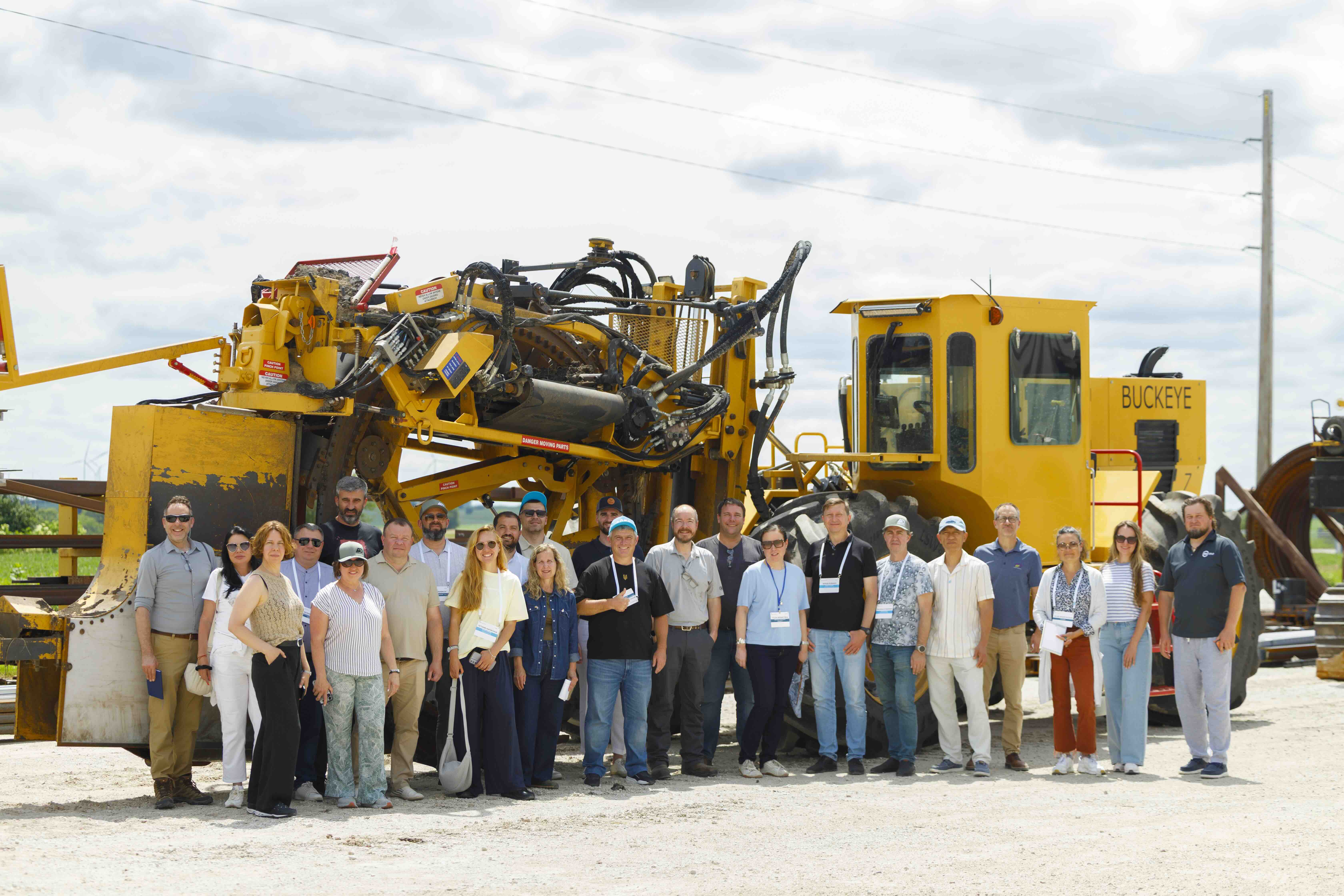
Photo Caption: DWFI hosted a delegation of Ukrainian water managers, agricultural leaders and irrigation stakeholders who traveled to Nebraska to learn about irrigation equipment, technologies and business. In the photo above, they are learning about irrigation tile technology at the Mid America Trenchers Corporate Headquarters in Dexter, Iowa.