
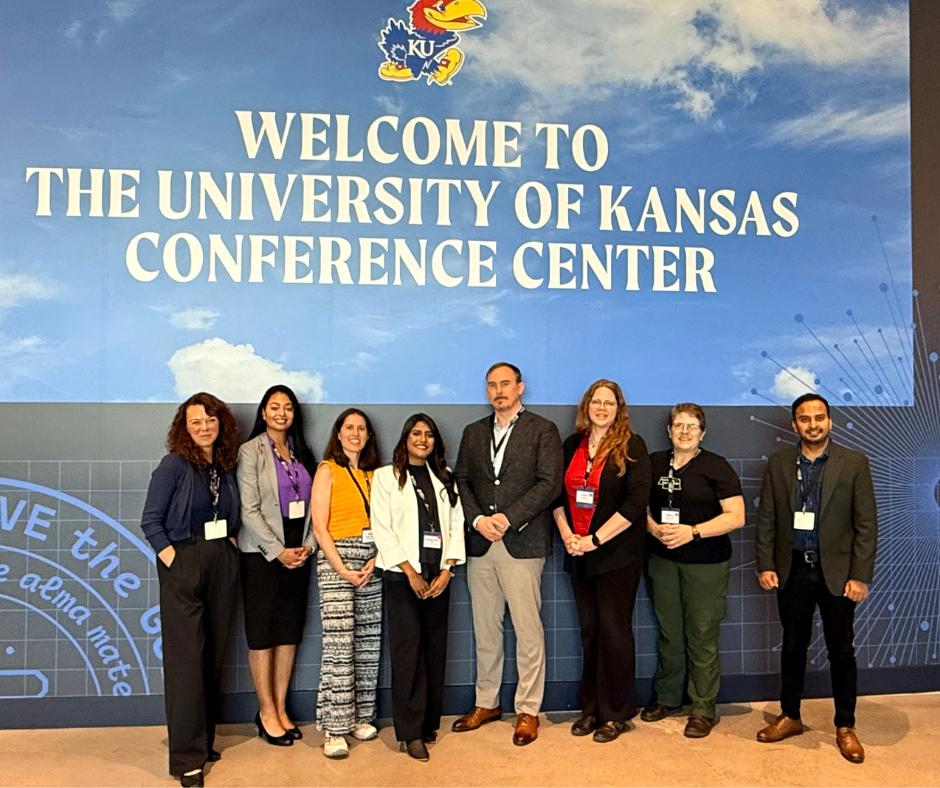
Photo Caption: Faculty and staff from DWFI's Water, Climate and Health Program and Nebraska Extension, including (L-R) Julie Petersen, Krista Brown, Anni Poetzl, Farzana Afrin Bithi, Jesse Bell, Crystal Powers, Becky Schuerman and Shivendra Srivastava attended the Central Plains Drinking Water Quality and Rural Health Symposium in Lawrence, Kansas on June 2, 2026.
By Taylor Dahl, Communications and Community Outreach Specialist, Water, Climate & Health Program, UNMC
Faculty and staff from DWFI’s jointly-led Water, Climate and Health Program and Nebraska Extension joined colleagues from across the region at the Central Plains Drinking Water Quality and Rural Health Symposium in Lawrence, Kansas, to discuss pressing water quality and public health issues affecting rural communities.
Hosted by the Kansas Geologic Survey in partnership with institutions throughout Nebraska, Iowa, Kansas, Missouri and Oklahoma, the conference brought together researchers, public health professionals and community leaders to explore solutions to shared challenges related to drinking water quality and availability.
Jesse Bell, PhD, DWFI Director of Water, Climate and Health, served as the conference's keynote speaker. Bell also leads the Water, Climate and Health Program, a joint effort between the University of Nebraska Medical Center (UNMC), DWFI and the University of Nebraska–Lincoln’s Institute of Agriculture and Natural Resources. His presentation focused on nitrate contamination in drinking water and its impact on human health.
"Rural populations, in particular, are more susceptible to water quality-related issues," Bell said. "If they're on private wells, those wells are not regulated by the Safe Drinking Water Act. It's up to the individual to test their well, and many families may be directly exposed to contaminants without realizing it."
The gathering represented one of the first large-scale efforts to bring together experts from across the Central Plains region to address common water challenges. While states often tackle water issues independently, Bell emphasized that many of the region's challenges are remarkably similar.
"A lot of times these conversations are being had in places like Nebraska or Iowa singularly," Bell said. "But in reality, we're all facing very similar problems. Let's come together and pool resources so we can work together to solve some of these issues."
Crystal Powers, DWFI Water and Cropping Systems Extension Educator, was invited to speak at the conference to provide an overview of the ongoing water quality initiatives in Nebraska, highlighting education, outreach and policy initiatives in Nebraska.
“I covered the basics of Nebraska water policy.” Powers said. “Everything from contaminants, policy, research and engagement. From groundwater festivals, high school education, working with farmers to addressing the immediate need for residents to make sure they have safe water.”
The conference also explored concerns related to pesticides, naturally occurring contaminants such as arsenic and uranium, water availability, drought and the impacts of extreme weather events on water systems.
Bell said communication and community outreach emerged as recurring topics throughout the conference's facilitated discussions.
"How do we do a better job of communicating with rural populations so they can test their wells and understand potential exposures?" Bell asked. "And how can we serve them as an academic institution through research that better understands the relationships we're seeing between contaminants and rural health?"
For Powers, looking at the big picture and showing it to colleagues across the Central Plains was important.
“People were very excited about what was happening in Nebraska between UNMC, DWFI and our educational efforts and the policy structures we have with our Natural Resources Districts (NRDs),” she said. A lot of the conversation at our engagement table was with other states wanting to learn from our robust platforms. I took away some good ideas from them as well.”
A major takeaway for Bell was the opportunity to strengthen regional partnerships while continuing to build on the work already being done in Nebraska.
"We're helping push the conversation forward,” said Bell. “But we also have a lot of interested partners throughout the region, and we should be working collaboratively to help each other move forward on these complex challenges."
Bell said he hopes the conference will continue in future years and attract even broader participation from organizations across the Central Plains.
"It was nice to see the different perspectives and the work happening across the region," he said. "The challenges are similar, but there are differences too. Bringing everyone together created an opportunity to learn from one another and think about solutions on a regional scale."
Visit Water, Climate and Health Program’s website to learn more.