

By: Claudia Ringler and Nicole Lefore
A common claim we hear in discussions about small-scale irrigation is that the technologies are simply too expensive, and that subsidies are therefore the only way to make them viable for smallholders. It’s a familiar argument--and on the surface, it sounds perfectly reasonable. If you search online, you’ll quickly find headlines reinforcing this idea. In India, farmers are described as unable to switch to solar-powered irrigation because the upfront costs are too steep; and in Kenya, affordability is raised as the key challenge to adoption. But once we look at actual field evidence, we find that reducing costs is far from the main—or only—solution for supporting smallholders in accessing irrigation technologies, and that subsidies are a blunt instrument for reducing farmers’ costs.
Perceived lack of access to water resources prevents investment in irrigation
While small-scale irrigation technologies do require investment, cost of the technology is often not the primary constraint. Other barriers show up as or even more strongly across multiple countries and studies. A recent survey of 600 Ethiopian farmers conducted to assess constraints and opportunities for solar-powered irrigation within a cluster farming intervention found that although 19 percent of respondents used irrigation, only 12 percent of those irrigators used groundwater, typically lifting water with diesel-operated pumps. Unsurprisingly, many communities reported a lack of water access as a key reason for not using irrigation technologies—equating the absence of visible surface water with the absence of water, given the invisibility of groundwater resources.
Knowledge gaps on technology options limit investments
Among the same 600 surveyed households, not a single one owned a solar pump. And while cost of the technology was a likely barrier, lack of knowledge of solar-powered irrigation loomed large. Specifically, 80% of surveyed farmers had no knowledge at all of solar irrigation systems; yet 60% of these farmers still said they wanted to buy such a technology. Sixteen percent of respondents had heard of the systems but didn’t know how they worked; 76% of these farmers still wanted to buy. Only 2% said they knew how to operate the technology — and even among them, 60% wanted to buy a solar-powered pump. So, if farmers don’t know that solar-powered pumps exist and how they work, they won’t invest—subsidy or not. And even if a farmer is interested and could afford it, they may have no idea where to buy a system or who would fix it if something breaks. These issues frequently outweigh cost. And, importantly, subsidies alone don’t solve them.
Subsidy programs for micro-irrigation systems can increase awareness of advanced irrigation technologies but face challenges in reaching poorer farmers
Uganda’s Intergovernmental Fiscal Transfers Programme (UgIFT) included a micro-scale irrigation program that subsidized the purchase of irrigation technologies for individual farmers. Between 2020 and 2025, the subsidy program installed around 5,100 irrigation systems, almost all powered by solar energy. To qualify, applicants had to upload proof of land ownership for the area to be irrigated, have an existing, reliable water source within 700 meters of their farmland, and contribute around 25% of the total system cost.
According to our survey data, co-financing averaged USD 1860 out of average total system cost of USD 7440. The full cost typically covered the installation of a solar-powered pump, a water tank, and distribution pipes. Farmers who obtained the subsidy were, on average, older, wealthier, and more educated than those who applied but were not selected—and applicants overall were better-off than non-applicants. Another indicator of the wealth of early adopters is that 88% were able to pay for the 25% contribution from their own resources. One key distinction between farmers who could apply for the subsidy and those who could not was access to an already developed water source—an essential requirement that most Ugandan farmers could not meet.
Nigeria: Evidence that costs can be within reach
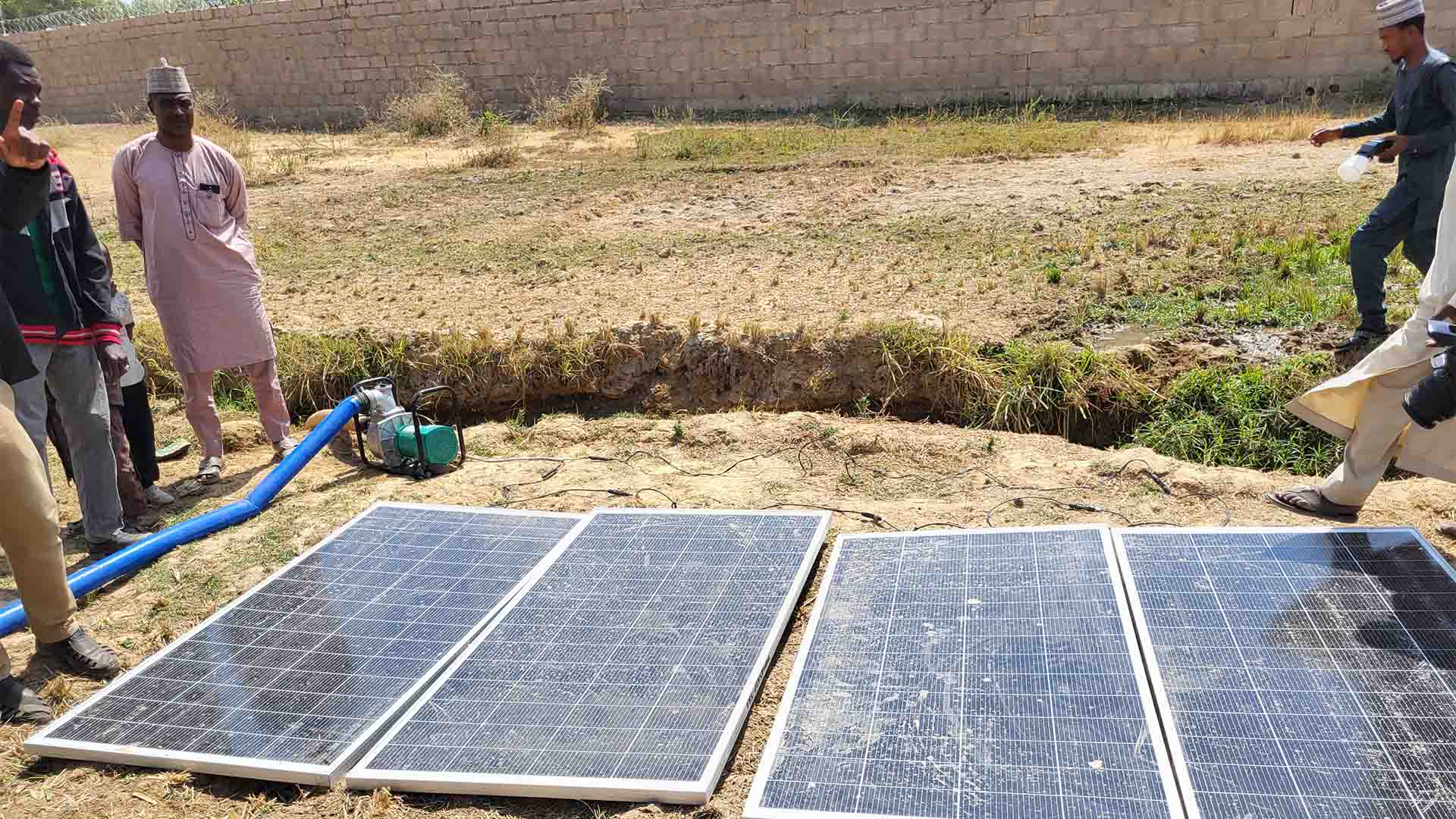
A recent visit to Kano, Nigeria, offered yet another perspective on the expansion of micro-irrigation in Africa. Like many countries across Sub-Saharan Africa, Nigeria is exploring a development of a subsidy program to accelerate farmers’ uptake of solar-powered irrigation systems. But in Kano, some entrepreneurial farmers are not waiting for government support—they are already innovating on their own. One farmer explained that he had purchased a solar irrigation system for about 350,000 Naira—roughly USD 500 at the time—consisting of four panels and a two-horsepower pump (see photo). With this setup he now irrigates five hectares using water lifted from an irrigation canal. His success immediately drew interest among fellow farmers who quickly took note on where he sourced the equipment. Falling technology costs (and raising petrol and diesel prices) are further fueling this momentum. The price of solar panels has dropped dramatically over the past decade, from USD 1.20 per watt in 2011 to just USD 0.14 today, making systems like his increasingly accessible, at least for medium-scale farmers.
So, are subsidies the answer?
The short answer is not necessarily. And certainly not as the first or only solution. Subsidies can help, but they tend to reach better-off farmers first and possibly only as most programs run out of funds by the time the richest farmers have received support. Meanwhile, major barriers—like water access, information gaps, and supply chain weaknesses—often remain unaddressed. If we focus solely on cost, we risk missing the parts of the system that need the most attention.
The takeaway is not that cost is irrelevant. It’s that the “too expensive, therefore subsidize” story is incomplete and often misleading. If we want small-scale irrigation to scale equitably, we need to look beyond the price tag and find ways for poorer, less educated, and less connected farmers to access government support, while strengthening the enabling environment of irrigation, including extension services that can support irrigators, value chains that ensure that competitively priced irrigation technologies as well as spare parts are locally available, and increased availability of information on sustainable groundwater resources.
About the series:
This blog is part of DWFI’s Smallholder Farming Mythbuster Series, which examines the narratives that too often shape how small-scale irrigation is funded, regulated, and supported. Drawing on research, field experience, and insights, the series addresses widely held assumptions about smallholder farmers, technology, cost, labor, and water use. By challenging outdated ideas and surfacing real-world data, the series aims to support smarter policy and investment, and better outcomes for the millions of farmers who depend on irrigation to secure their livelihoods and feed their communities.