


This piece explains absolute poverty and argues that small-scale commercial agriculture is central to economic development. It highlights the growing push to transform Africa’s agricultural sector and outlines how the Daugherty Water for Food Global Institute (DWFI), the University of Nebraska and the State of Nebraska are well positioned to partner in this effort.
What does poverty mean?
Poverty, or the state of being poor, can be hard to define. It depends on where a person lives, whether we mean absolute or relative poverty, or individual or societal poverty. It can also depend on a person’s basic needs; whether they support other people; their specific health needs; and so on. Someone considered poor in Switzerland might be thought of as enviably wealthy by a person in Burundi. A comfortable income in a rural part of the USA might feel precarious in New York City. It also depends on who you ask, since perceptions of poverty are also important. Sometimes the word “poor” is even considered belittling, and other terms like “low-income” are preferred.
The concept of extreme poverty cuts through the fog. Extreme poverty is a state of poverty so severe that the person cannot afford basic necessities like food. The World Bank considers that anyone with an income lower than $3 USD per day is extremely poor, by any standard, anywhere in the world.
Living on less than $3 per day is a constant struggle. A setback that would be small for most people—like a minor illness or injury that prevents a person from working for a few days—can be life-threatening to an extremely poor person. Getting enough calories to survive or accessing basic healthcare are much harder for those who are extremely poor.
About nine percent of the today’s global population, or about 800 million people, are considered extremely poor. This is down from about 47% of the world’s population in 1981. (In 1981, the world’s population was about half of what it is now, and just over two billion people were extremely poor.) Globally, we are making tremendous progress; although 800 million people are still far too many.
Another big shift has happened since the early 1980s. At that time, most of the world’s extremely poor people lived in Asia. Growing economies and poverty eradication programs in Asian countries, particularly China, have dramatically lowered the numbers of extremely poor people in Asia. Today, most of the world’s extremely poor people live in Africa, particularly south of the Sahara.
Sub-Saharan Africa accounts for 16% of the world’s population but is home to more than half of the world’s extremely poor. Roughly 480 million people in sub-Saharan Africa today live in extreme poverty. Since the population of sub-Saharan Africa is growing quickly, the region needs to run just to stand still; it must help raise the extremely poor out of poverty while also making provision for future generations.
In the 1990s, Nigeria, Lesotho, Madagascar and Zambia had poverty levels much the same as China, Vietnam and Indonesia, according to the World Bank and the Institute for Security Studies. While Asian countries have greatly reduced extreme poverty since then, African countries haven’t made the same gains. In some African countries, most of the population are extremely poor subsistence farmers. There are several reasons for this and much debate over what can be done to close the gap between Asia and Africa. However, there is wide agreement that an important component of a country’s journey out of poverty is the transformation of its agricultural sector. How a country farms and who does the farming, it turns out, is profoundly important.
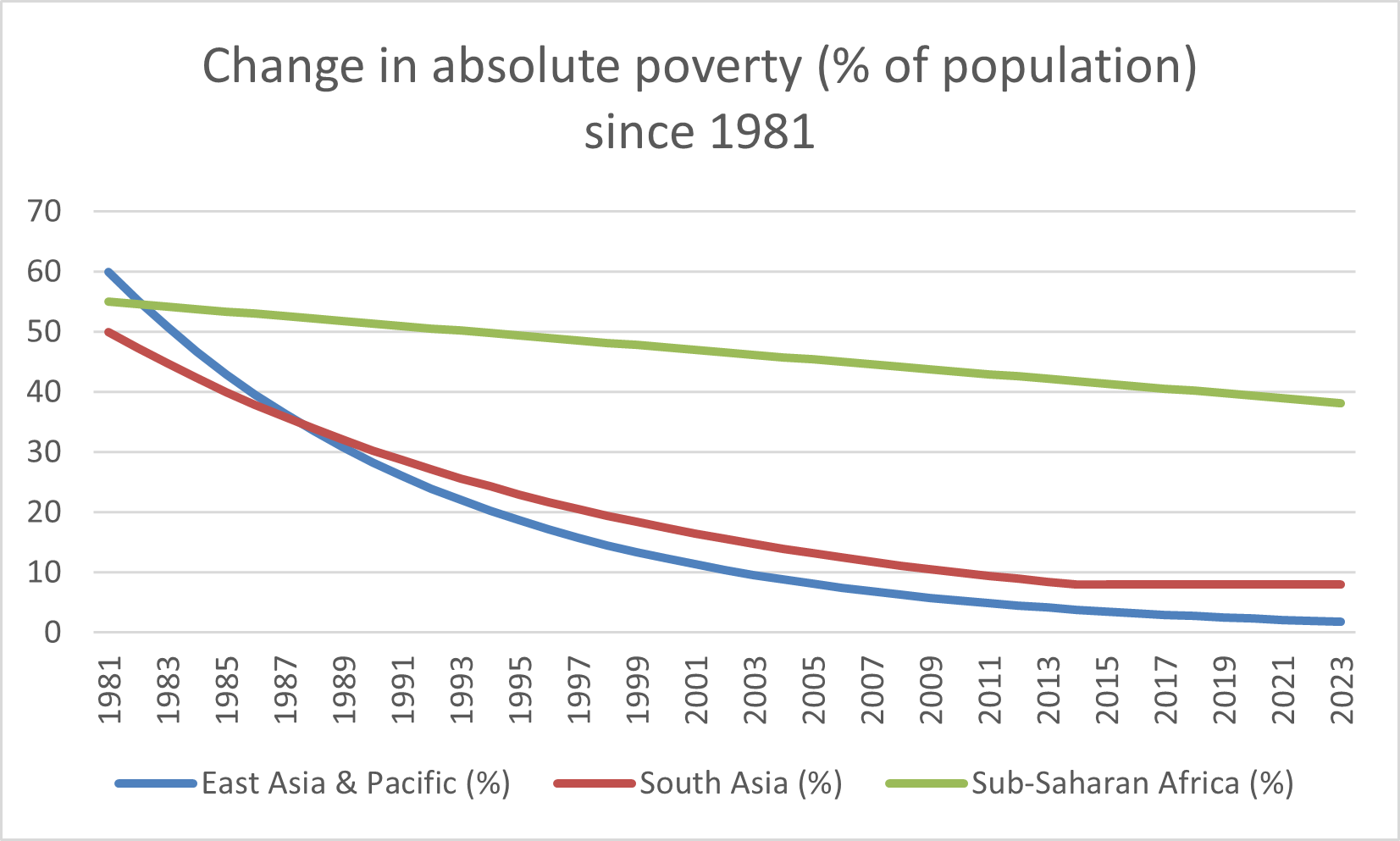
Figure 1. Line graph showing changes in absolute poverty by percent of population from 1981 to 2023. East Asia & Pacific and South Asia drop sharply from 50-60% to 0-10%, while Sub-Saharan Africa declines just slightly from 55% to 38%.
Growth and change in agriculture
For many hundreds of years, most people on earth were subsistence farmers, depending on small plots of land and their own hard labor to eke a living from the soil. In good years, a small surplus might be produced for sale, but most of what was grown would be consumed on the farm or perhaps bartered with neighbors. In bad years, famine and death were real possibilities.
Outputs from traditional agriculture are not only low, but also highly variable. Only a small elite, like members of the clergy, royalty and those holding specialist occupations, were able to escape the daily toil of subsistence farming. Lifespans for most people were short, educational opportunities were limited and few traveled far from where they were born. Agriculture wasn’t a chosen occupation or a specialist skill; it was simply what everyone did to survive.
In the early nineteenth century, around three quarters of all Americans were employed in agriculture. As recently at the 1920s, about a quarter of all Americans worked the land. However, fewer than one in a hundred Americans is directly employed in agriculture today. Despite this, modern farmers produce much more than farmers in the past.
Agriculture has been modernized and mechanized and now feeds a population three times higher than it was in the 1920s, while also producing large surpluses for export. Machines, combined with knowledge and a scientific approach, have changed the sector beyond the wildest dreams of farmers a century ago.
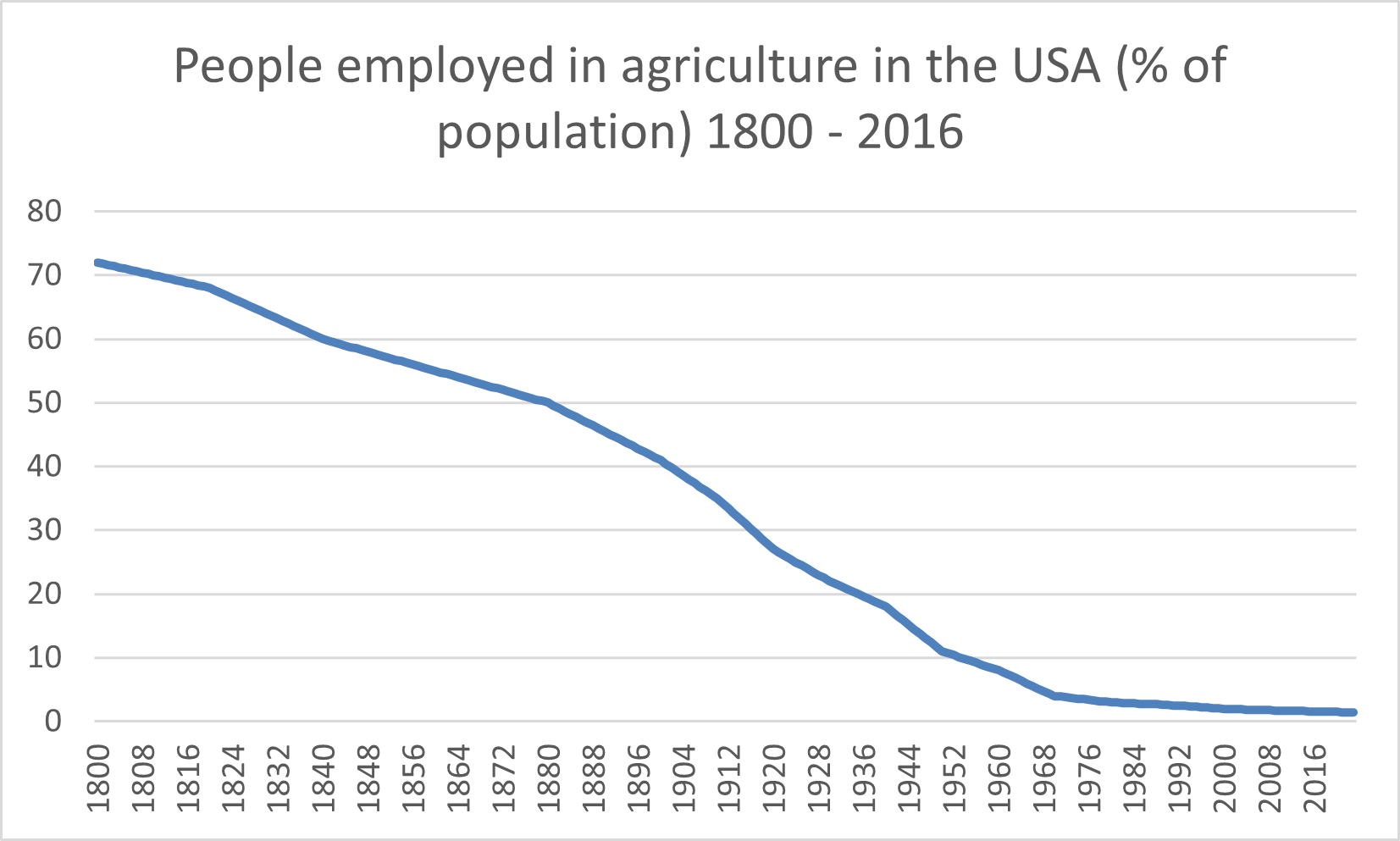
Figure 2. Line graph showing the decline in the percentage of the U.S. population employed in agriculture from 70% in 1800 to below 2% in 2016 with a steady drop to 5% until 1968 and then a slower decline.
The transformation and radical productivity gains in agriculture in north America and Europe, and increasingly in many other countries like China, India and Brazil, have enabled several things to happen which are key to economic development:
- Increasing demand for goods and services: Agricultural development creates demand for goods and services in rural agricultural areas where poverty is concentrated. This is why agricultural development tackles poverty more effectively than growth in other sectors.
- Enabling specialization: Agricultural development frees up most people to do highly productive tasks such as working in specialist industries in cities. Or even conducting research into agricultural challenges.
- Earning valuable export revenue: Agricultural development earns foreign currency for the country, which can buy imports of industrial machinery, minerals, medical supplies, and myriad other modern essentials.
- Boosting food security: Agricultural development allows a country to be food secure and set its own course, free of dependence on others for food or the obligation to find revenue or loans to pay for food imports.
- Supporting urbanization: Agriculutral development helps enable a transformative urbanization in which the majority live in cities, and more easily access jobs, healthcare, education, and entertainment. Arguably, the growth of modern cities and accompanying culture, politics, and commercial activity is the defining feature of the modern industrial world.
- Increasing land-use efficiency: Agricultural development enables efficient use of land since modern irrigated farming can produce much more crop from the same area of land.
- Anchoring rural infrastructure: Agriculutral development goes hand in hand with the development of infrastructure in rural areas such as roads, electricity, telecommunications, and government services
A few words about development
Let’s pause to ask a question: What do we mean by development? Most people would agree that reducing the numbers of extremely poor people would be “development.” But the economic development of a nation is more than poverty alleviation. It implies the radical transformation of many economic sectors, the creation of new sectors and the accompanying enormous demographic, infrastructural, industrial, social and cultural changes.
We can look at South Korea as an example. In the 1960s, most South Koreans worked the land as subsistence farmers, just as their parents had and their grandparents before them. Most were extremely poor. Life was precarious, and opportunities for ordinary people were few. A South Korean subsistence farmer in 1960 probably could not imagine that her grandchildren would be working as microchip engineers, schoolteachers, or fashion designers in the glittering urban centers of modern Korea in the 2020s. And her grandchildren would probably struggle to really appreciate what life was like for her when she was their age. South Korea has gone from a low-income, rural country in the middle of the twentieth century to a high-income and mainly urban country today, with all the myriad accompanying benefits. And all this is within living memory.
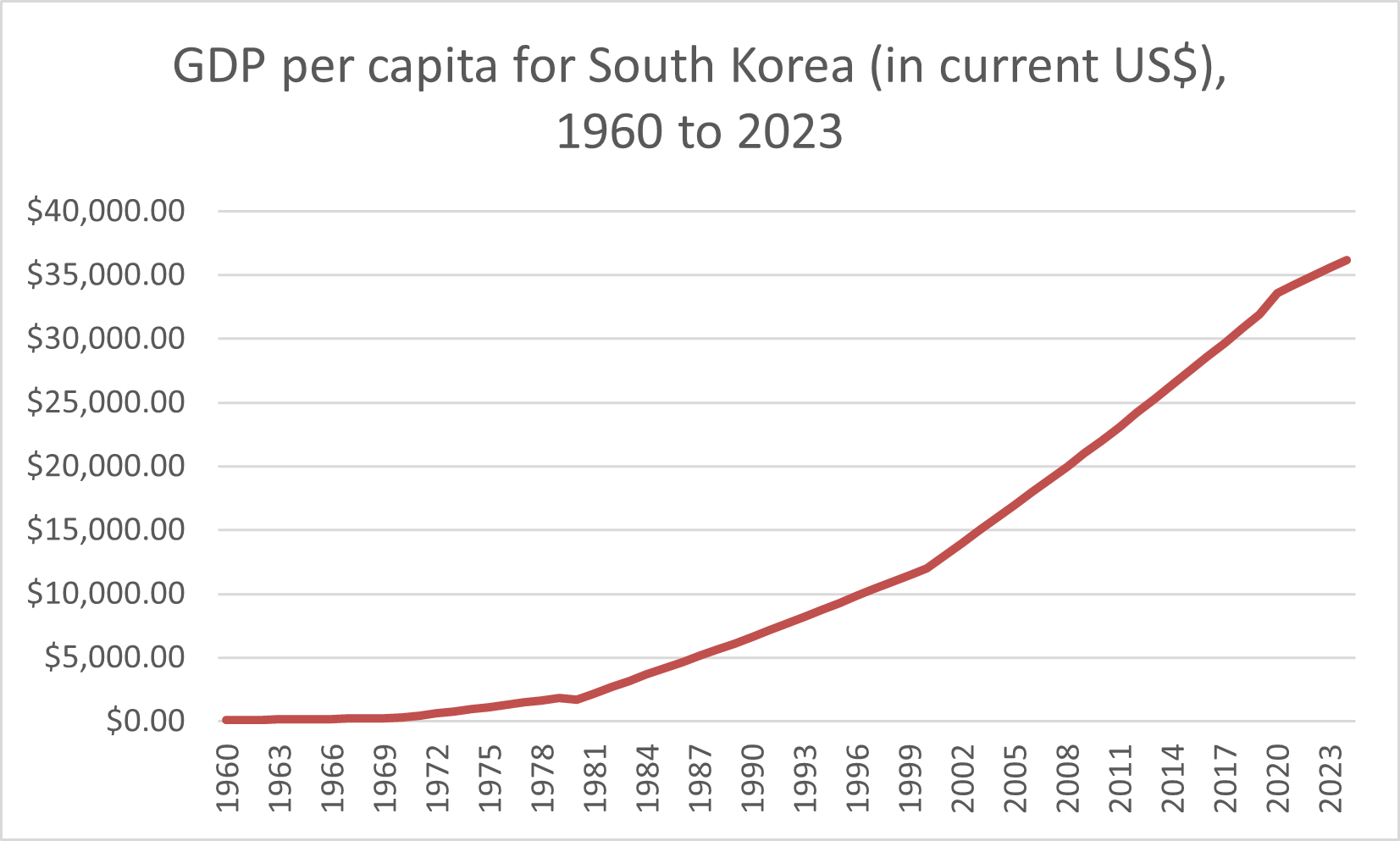
Figure 3. A line graph depicting the GDP per capita in South Korea from 1960 to 2023. GDP per capita starts at about $100 in 1960, then shows a sharp upward trend, especially post-2000, reaching nearly $40,000 in 2023.
Unfortunately, rural agrarian subsistence life is still sometimes romanticized. At first glance it can seem simpler and honest, more in touch with nature and the natural rhythms of the environment. It can seem healthier (organic food, lots of exercise and less pollution!) and more socially connected. In contrast, modern life in contemporary cities can sometimes seem artificial, stressful, commercialized and isolating. Some people might be tempted to ask: Do we really want more countries to become modern, urban societies? Or even: Do we really need industrial development and growth?
The reality for most subsistence farmers, in most places, is almost unimaginably tough. Poor subsistence farmers have shorter and less healthy lifespans than other people and suffer debilitating stress just trying to survive. Women, younger people and lower castes struggle for equality. Access to healthcare, justice, banking, transport, education and entertainment are very limited. Unelected traditional leaders often control critical resources such as land or water. Infant mortality is high and chronic disease is more common. This is why the Human Development Index (a United Nations composite measure of health, longevity, education and standard of living) is so strongly correlated with national income.
Let’s not romanticize poverty, nor glorify subsistence farming. Most subsistence farmers would gladly swap their daily toil on the land for a well paying job, access to healthcare and a house in town. And most low-income countries want nothing more than to move out of that unenviable category.
So, how can countries develop?
How do we get from low-income, rural, subsistence farming-based societies to modern, industrial, high-income societies? How does the kind of economic and demographic transition that occurred in South Korea actually happen? How does it even start? This is a huge question, probably with about as many nuanced answers as there are people asking it. But there is a strong body of evidence to suggest that the transition starts in the agricultural sector. And it starts with a certain category of people: small commercial farmers.
Small commercial farmers are not the same as subsistence farmers—although they may well have been subsistence farmers at one time. Small commercial farmers tend to farm areas of land that are larger than subsistence farms—about 10 acres or more, compared with the one or two acres that a subsistence farmer relying on manual labor can manage. Small commercial farmers produce a surplus for sale (usually at least a third of what they produce), and they spend those earnings on goods and services in the rural areas where they live. They also tend to employ other people on their farms. Over time, rural areas with concentrations of small commercial farmers give rise to small market towns, where there are opportunities for employment in secondary industries such as pump repair, restaurants, construction, seed supply, banking, transport, clothing, etc. Virtuous circles of development begin to happen as these secondary businesses flourish and demand for goods and services grows further.
Inevitably, not everyone can or wants to be a small commercial farmer. Many former subsistence farmers might choose to take up employment opportunities on commercial farms or in the various secondary industries enabled by the commercial farming sector. Typically land holdings consolidate, with fewer people farming larger farms.
Crucially, none of this can happen without government or public sector input. Only government can provide some of the essential inputs to the growing commercial agricultural sector. These include all-weather roads into rural farming areas so that farmers can get their crops to market and access other services. Rural electrification is also critical, powering irrigation pumps or cold storage, for example. Government also provides the legal, administrative and institutional framework for business that keeps the playing field level and ensures fairness, secures private property, and underpins security and accountability.
The public sector also typically steps in to provide or backstop the scientific support and extension to emerging commercial farmers that is the lifeblood of highly-productive, mechanized agriculture. Each farming area and crop has unique scientific challenges and off-the-shelf solutions only go so far. Dedicated, focused scientific extension and research are essential. Finally, government provides an over-arching vision and direction that keeps a country and its farmers focused on the critical role of commercial agriculture. The role of government diminishes as a country modernizes, and the growing private sector takes over many of the early government functions.
Government’s role at the beginning of the agriculture-led economic transition is crucial, but government can also get in the way of the development of commercial agriculture. Onerous or duplicative processes for approving imports of chemicals or spare parts; uncertainty over land tenure or water licensing; difficulties with export permits; unnecessary foreign exchange restrictions; corruption in obtaining permits; and many others are examples where government may be hindering rather than helping the development of this important sector.
Government underfunding, corruption or ineptitude in several African countries has led some advocates of commercial farming to argue that the sector should operate with minimal government involvement. Such a position is understandable, but it is undeniable that there are many essential inputs that only government can supply, facilitate or regulate. A government that is laser focused on agriculture sector growth is essential.
Investment in the fledgling commercial agricultural sector and the infrastructure that it needs is not cheap. This is why governments in low-income countries are urged to increase spending in this area: to at least ten percent of national income as recommended by the African Union, with annual growth of at least 6%. This might seem high, but the price is worth it if it means a permanent transition away from low-income, subsistence-based agriculture.
National development plans of many African countries emphasize rural transport and electrification, alongside serious investment in scientific research and extension in agriculture. Investment in these things, although expensive, can pay huge dividends if the agricultural sector transforms accordingly. In China, for example, returns on investments in rural roads were as high as 50% once the sector began to transform.
What’s the rush?
There is a reason for urgency: while slow and steady growth in the agricultural sector might seem acceptable, research shows that growth of less than around 3% can paradoxically lead to increases in unemployment and poverty. In other words, there is a threshold below which the kind of transformative change needed simply does not happen, and a country can remain in poverty. The momentum needed to give rise to small market towns and secondary services is simply not there.
Modest progress is sometimes little better than no progress at all—it may serve as a charity bandage rather than a long-term solution. As mentioned, the key is small commercial farmers. This is why, paradoxically, focusing on the very poorest subsistence farmers may not be the quickest way to beat poverty. Each extra year of poverty means hundreds of thousands more blighted lives and premature deaths. The one resource that really is in short supply is time.
Here’s an example:
One example of a burgeoning hub for commercial agriculture is the town of Naivasha in Kenya. In some ways it is the perfect place to grow things: it sits at an altitude of about 6,100 feet above sea level, giving it a temperate climate. It is near the equator so it gets year-round sunshine, meaning crops can grow continually if they have enough water. And it is on the banks of Lake Naivasha, a large freshwater lake that, along with local groundwater, supplies plenty of irrigation water.
But Naivasha is not successful by chance; targeted government policies and infrastructure investments have helped establish it as a significant agricultural powerhouse. The private sector has responded, and many small and medium-sized businesses have established themselves in and around the town. Farmers around Naivasha grow flowers and delicate fruits like strawberries in rows of greenhouses. Avocados and vegetables like purple broccoli French beans are grown in fields under center pivot irrigation systems.
Not only do these farms need a lot of people to work in picking and processing, but they also need seedlings, greenhouse plastic, vermiculite, fertilizer, and other inputs that local businesses provide. Workers on the farms and in the businesses supplying the farms, need food, clothing, housing, transport, and consumer goods, stimulating further economic activity.
The agriculture sector and associated business enterprises also need specialist knowledge so there is a role for agricultural research and extension too. More efficient ways to grow crops, use water and save energy, as well as less harmful approaches to fertilization and pest control are increasingly needed, underscoring the importance of the research sector.
What is the role for Nebraska and its land-grant university?
What are the implications for the University of Nebraska and the state, and what partnership opportunities does this present?
First, our knowledge of high-tech solutions in commercial farming is extremely valuable, and it’s rare. We need to consider how we can tailor Nebraskan knowledge of successful, profitable farming to the local context in Africa where know-how and extension are still limited. What kinds of partnerships or training courses are best? Two-way dialogue is essential since the local African context is critical and one size most certainly does not fit all.
Second, agricultural transition also implies a transdisciplinary focus, since many knowledge areas need to come together to realize transformative development. For example, knowledge of road network design, agrochemical management, water use efficiency, crop processing, and market dynamics are all important nuances. Each area can also impact other areas in unexpected and even counterintuitive ways. As a land grant university, the University of Nebraska brings together experts from across agriculture-related fields, making it well suited to address these complex challenges through a systems approach.
Third, the state of Nebraska and the University of Nebraska already have research partnerships with several countries in Africa and Asia, as well as connections with African decision-makers (including in Kenya). We continue to leverage and build on these, as personal relationships are vital.
It can get messy
Finally, it is important to acknowledge that national development and structural change are inherently complex, unpredictable and often messy. For example, irrigation transformation on small farms in south Asia during their green revolution was summarized by one famous water specialist in a single word: anarchy.
There are blind alleys and unexpected setbacks along the way. Some groups of people will end up worse off—hopefully only a small minority and temporarily, but there are no guarantees. Infrastructure must be built and resources must be used. Hard choices must be made. In the long run, the environment will be better protected, but this may not be obvious at first.
Unfortunately, some governments (and even some aid partners) have neither the political mandate nor the will to support the necessary changes. As a result, their work can unintentionally shift toward short-term fixes for poverty, inadvertently perpetuating cycles of dependence. Remember, slow growth can mean more poverty, paradoxically. At worst, some development professionals may focus on reshaping subsistence farming in ways that reflect donor priorities more than the aspirations of African communities or the long-term plans of African governments.
Given the uncertainty, there is little to be gained from trying to choose who will be an emerging commercial farmer and who will not. It is better to simply partner with and support those who already show early promise. Research is clear; structural economic change needs to focus on small or emerging commercial farmers, and DWFI and the University of Nebraska are uniquely positioned to lead and scale this work.
There is much to be done, yet growing evidence shows that meaningful change can take hold with sustained focus and long-term commitment.
References
The two primary references for this piece are:
- Mellor, J.W. 2017 Agricultural Development and Economic Transformation. Palgrave Macmillan, an imprint of Springer Nature. Cham, Switzerland.
- Hirschman, A.O. 1970 The Strategy of Economic Development. Yale Paperbound, Yale University Press, New Haven, CT, USA.
Sources of data and numbers for text and charts:
- https://datatopics.worldbank.org/world-development-indicators/stories/where-do-the-poor-live.html
- https://ourworldindata.org/grapher/number-of-people-employed-in-agriculture?country=~USA
- https://pip.worldbank.org/poverty-calculator
- https://pip.worldbank.org/about
- https://www.fao.org/faostat/en/#data/IG
- https://ourworldindata.org/data-insights/one-in-six-people-live-in-sub-saharan-africa-but-it-accounts-for-two-thirds-of-global-extreme-poverty
- https://issafrica.org/iss-today/africa-is-losing-the-battle-against-extreme-poverty